
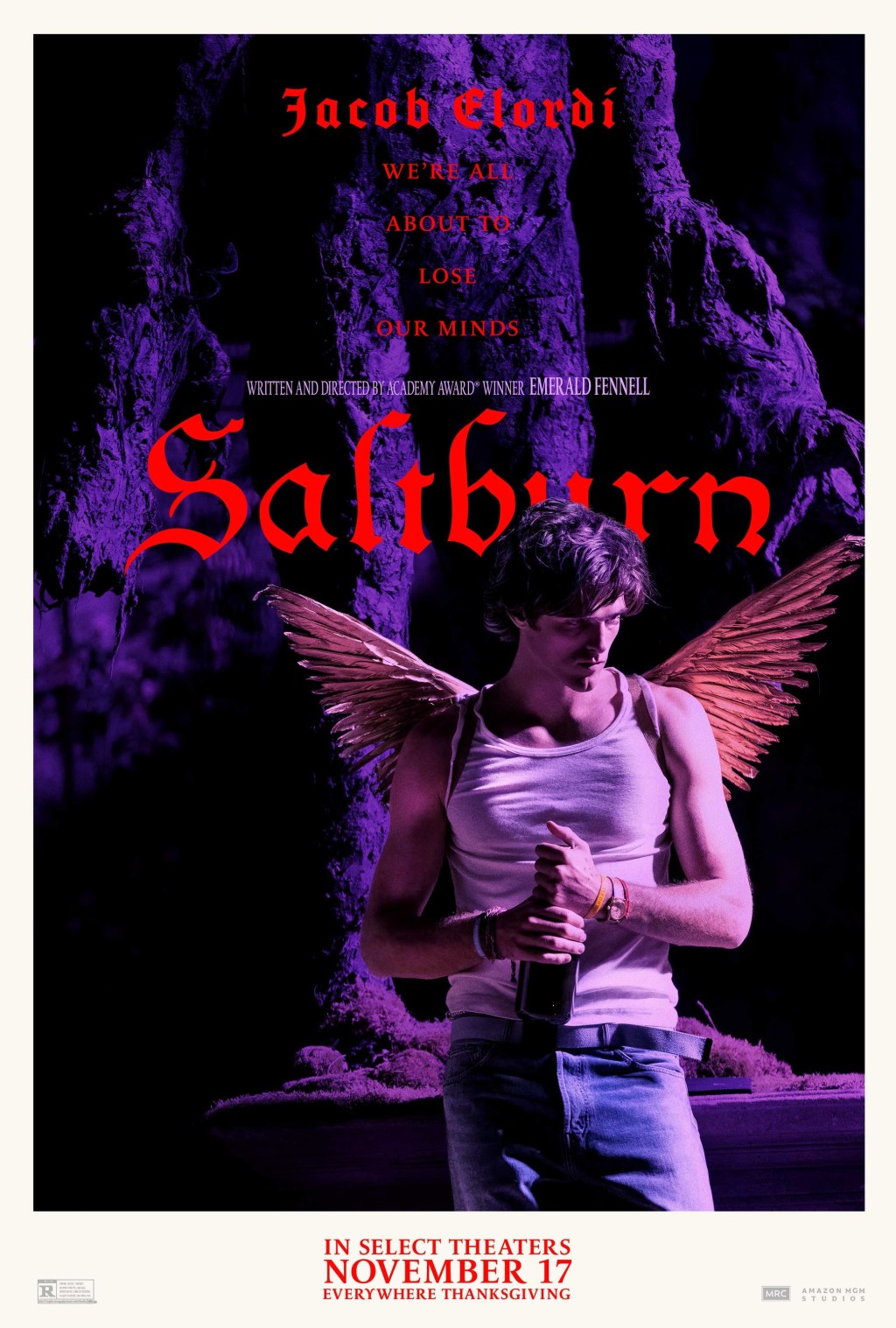
*Note: The Bible is used as a historical reference to elucidate certain parts of the Christian worldview, wherein the architecture and beliefs of the English nobility have been widely noted. This is meant to shed light on the Bible as a literary work and is not making an argument for the existence of a deity, but rather providing context for the story.*
“By the abundance of your trading
You became filled with violence within,
And you sinned;
Therefore I cast you as a profane thing
Out of the mountain of God;
And I destroyed you, O covering cherub,
From the midst of the fiery stones.”
– Ezekiel 28:16, NKJV
Most people do not know what to make of Saltburn (2023). It is touted as an “Eat the Rich” narrative, a phrase which finds its origin in Jean-Jacques Rousseau who once said, “When the people shall have nothing more to eat, they will eat the rich.” But Oliver, the main character of the film, while not wealthy, is of the upper-middle class. Many have accused it of copying other films while having nothing original to say – that it is the lesser brother of The Talented Mr. Ripley (1999) that won’t pick up the check (though Mr. Ripley itself was a retelling of a James Joyce story). Yet Saltburn is more than the sum of its inspirations numbering from Brideshead Revisited (2008), The Virgin Suicides (1999), A Midsummer Night’s Dream, to even horror movies like The Cook, The Thief, The Wife, and His Lover (1989). I adore this movie. Since it came out, I think that I saw it four times intentionally, and even more than that, passively, in the background while doing other chores. But I think it’s more interesting than Jacob Elordi looking gorgeous with an eyebrow ring, than Barry Keogan nude and dancing through a castle, and more interesting than a half-baked retelling. Saltburn is about what if the Prince of Darkness (Lucifer, the Devil, the Accuser and any other name) won Heaven. It is a modern Paradise Lost. However, in this version, the Prince of Darkness wins with Oliver as our Lucifer. Felix and his family are meant to be the flawed, ignorant, heavenly angels and God. The general story of Lucifer was that he was the most favored most beautiful angel, but eventually became too proud, tried to revolt with a third of his fellow angels, and was cast out of Heaven into Hell. Arguments of freewill and true love abounding, this is why we have evil in society – at Lucifer’s urging and hatred of God. It was a straightforward narrative until Milton (Though if you really wanted you could argue Paradise Lost was the first true biblical fan fiction).
In Milton’s epic poem, Paradise Lost, one of the first Bible fanfictions, Lucifer is shown as a sympathetic creature. The poem starts after Lucifer and several angels are thrown out of Heaven and he decides to go to Earth to take down God’s new favorite creation: humankind. The battle between Heaven and the rebellious angels is told from several perspectives. Eventually the ending of Paradise Lost sees Lucifer having corrupted man, but also, he and his angels are turned into snakes. Lucifer loses, but so does humanity until God can send his son to atone for the sins of humanity. One walks away from the poem sympathetic to the plight of not only Man, but oddly, Lucifer. It challenged the perspective of the time that evil was simple because of one simple factor. Paradise Lost is a modern masterpiece and paved the way for Biblical interpretations, everything from Jesus Christ Superstar (1971) to The Prince of Egypt (1998). In the Saltburn version, Lucifer is tossed from Heaven but comes back and is successful in their rebellion. What is more anti-establishment or queer than that?
Throughout Saltburn we see the character Oliver Quick fall in love with and then ruin the life of his landed gentry friend/obsession, Felix, eventually killing him off and his immediate family. Felix’s family owns a centuries-old estate called “Saltburn” and by the end of the film, it belongs to Oliver. We are then treated to a montage at the end of the film, answering the question posed at the beginning: did Oliver really love Felix? He answers, “I loved him, but sometimes, I also hated him.” How could this be? What if, Lucifer (the enemy, the fallen angel etc.) loved God so much that it turned into hatred? Historically speaking, gay love stories often turn from devotion into hatred – in other words, the only result of a world that will not let you be with your beloved is to turn them into an object of scorn to maintain the obsession. But Oliver and Felix could never love as equals. Love is meant to be the great equalizing force. It is how people from different faiths, regions, races, and wealth-statuses can hope to find one another. Love equals the footing. What if you love someone higher than you? What happens when you are an angel, who falls in love with God, a being who you can never equal? What if Saltburn is the story of how the Devil would get his way? Unable to possess God, or possess Heaven, the Devil comes for God and his family. Indeed, is it any coincidence that Oliver sins in all the ways that God hates, to obtain Saltburn and kill off the family at the heart of it?
“There are six things the LORD hates, seven that are detestable to him: haughty eyes, a lying tongue, hands that shed innocent blood, a heart that devises wicked schemes, feet that are quick to rush into evil, a false witness who pours out lies and a person who stirs up conflict in the community.”
(Proverbs 6:16-19, NIV)
I. Oliver thinks of himself better than most people, not least of all the classmates who try to befriend him, specifically the mathematics student, and anyone who would keep Saltburn and/or Felix from himself. Farleigh, Felix’s cousin, on several occasions, tries to drive a wedge between the two – at first with subtle put downs and then with telling that Felix’s sister and Oliver had sex.
II. Oliver lies to everyone, but especially to Felix, saying that his own father died to pull Felix back to him. He’s the one who punctured Felix’s bike tire, facilitating their meeting. He lies about having money so Felix can come in and save the day by paying a beer tab. Oliver also lies about sleeping with, not only Felix’s cousin and sister, but Felix’s ex-girlfriend as well.
III. One could make the argument over who in Felix’s family is truly innocent, if one wanted, but Oliver does kill Felix, whose only true crime that we’re shown was being a flakey college boy. Felix is gorgeous and fickle in his affections.
IV. Oliver devises the most wicked scheme of all: killing an entire family to inherit “Heaven” and thus make himself the sole beneficiary. He encourages the suicide of Venetia (Felix’s sister), spikes the wine that Felix drinks ensuring an overdose, incurs the banishment of Farleigh (the cousin of Felix), and pulls breathing tube out of Felix’s dying mother, Elspeth.
V. Oliver makes quick work of worming his way into the inner circle of Felix’s life. He appeals to Elspeth’s vanity and encourages her ungenerous nature, he appeals to Felix’s father by learning about the familial estate, he sleeps with Venetia and Farleigh in equal measure. He even lashes out at Felix and says the reason that Oliver lied about coming from a broken home was because he knew that Felix wanted to have a “pet” of sorts.
VI. Oliver claims that his cousin, Farleigh, is lying about seeing Oliver seduce Felix’s sister, Venetia, (which he absolutely did), and then also seducing Farleigh. We also see the lie that Oliver’s father is dead and his mother a drug addict shattered. In fact, neither parent is a drug addict nor abusive as Oliver claimed.
VII. Oliver stirs up conflict by turning Felix’s cousin and sister against him, as well as Felix’s mom against a certain house guest, Pamela.
Felix is the god-figure and the favored son; he must die so that Saltburn may go to Oliver. Same goes with Venetia. They must die so Oliver may inherit the Kingdom. The undeserving family at the heart of Saltburn and all the riches around them inherited their wealth. In the same way that Christians are inherited into the kingdom of heaven with the love of God and Jesus’ sacrifice. Oliver rightly sees that they do not deserve Saltburn, but he does. He puts in the work of obtaining it. By the end of the film, the estate is his, and Oliver is alone. He rejoices, naked, dancing through the Saltburn manor, to the tune of “Murder on the Dancefloor” by Sophie Ellis-Bextor – an excellent choice of filmmaking. Heaven with no occupants and no life becomes Hell, doesn’t it? It puts one in mind of the great classic The Great Divorce by C.S Lewis about what Hell and Heaven would be like. In Hell, the “great men” of history live in great big castles and mansions, alone and far from anyone else. In possessing Heaven, the Prince of Darkness makes it into his own Hell. The enemy has won. He is in paradise, but he is alone.
As the old saying goes, “Better to reign in Hell than to serve in Heaven.”
 ALEXANDRA AVILA